
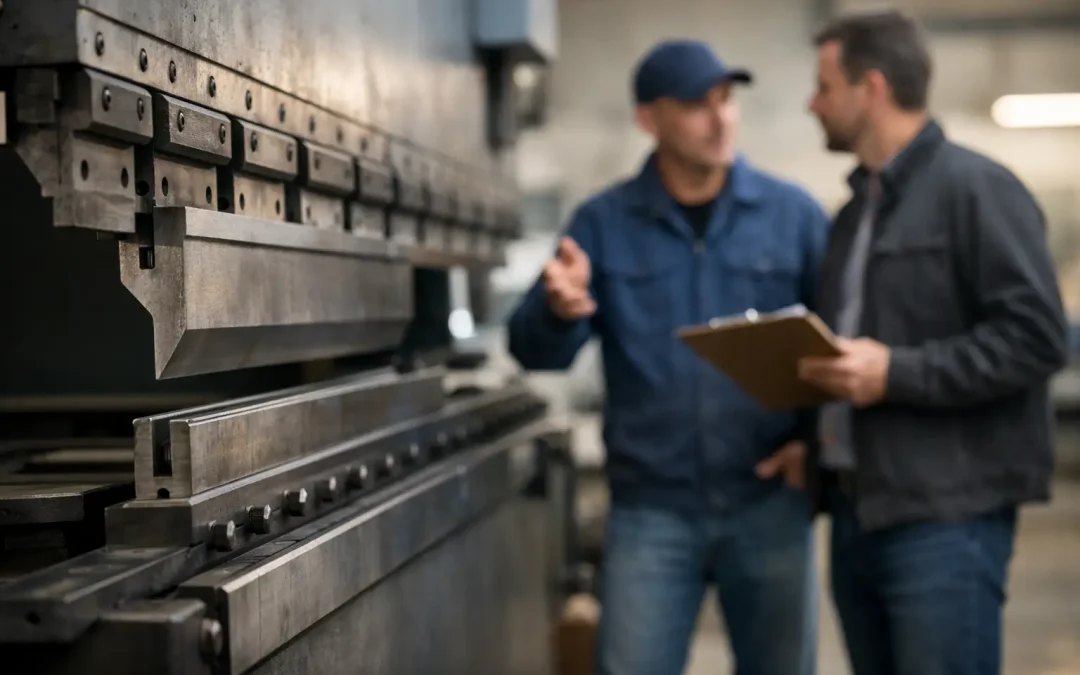
A press brake that looks like a bargain can become an expensive production bottleneck if its tonnage, bed length, controls, or tooling do not match the work on your floor. Knowing how to buy used press brakes starts with defining the parts you need to form, then verifying that the machine can deliver that result reliably, safely, and within your available budget.
Used equipment can be an excellent capital-efficient choice. A well-maintained machine from a recognized builder may provide years of service at a significantly lower cost than new equipment. The key is to evaluate the entire transaction, not just the advertised price.
Start With Your Actual Forming Requirements
Before reviewing inventory, establish the production requirements that will drive the purchase. Press brake capacity is not a single number. Tonnage, bending length, material type, material thickness, die opening, bend method, and part geometry all affect whether a machine is suitable.
A shop routinely bending short, heavy-gauge brackets may need substantial tonnage but not a long bed. A fabricator producing architectural panels may prioritize a longer bending length, backgauge travel, and repeatable CNC positioning over maximum tonnage. Buying excess capacity can tie up capital unnecessarily, but buying too little capacity can limit jobs and create safety concerns.
Document the materials and thicknesses you run most often, your longest planned bend, typical flange dimensions, annual part volumes, and required bend tolerances. Also consider the next two to three years of expected work. A press brake should support current production without preventing reasonable growth.
Understand Tonnage Ratings and Limits
A machine rated at 175 tons is not automatically capable of every 175-ton bending job across its full bed length. Tonnage requirements vary with material tensile strength, bend length, die opening, and bend method. Concentrated loads can also exceed the allowable load in the center of the bed or near the ends.
Ask for the machine’s tonnage chart and review the manufacturer specifications where available. Confirm whether the stated capacity applies across the entire bed length and whether the work you plan to run creates concentrated loading. This is one area where an experienced machinery partner can help prevent a costly mismatch.
Choose the Press Brake Type That Fits the Work
Most used press brake buyers will be evaluating mechanical, hydraulic, or electric machines. Each has practical advantages, and the right choice depends on production needs and service expectations.
Mechanical press brakes can be durable and productive for straightforward forming operations, but they generally offer less control and flexibility than modern CNC hydraulic machines. They may be a fit for shops running consistent, less-complex parts with trained operators and established tooling.
Hydraulic CNC press brakes are widely used because they offer programmable ram control, repeatability, and flexibility across a broad range of parts. Inspect the hydraulic system carefully, especially on older machines, but do not assume age alone makes a machine a poor investment. A properly maintained hydraulic brake from a respected manufacturer can be a dependable production asset.
Electric press brakes can offer speed, energy efficiency, and reduced hydraulic maintenance. However, the used market may provide fewer options, and repair support or proprietary components may deserve closer attention. The best value is not always the newest control or the fastest cycle time. It is the machine that performs your work consistently with support and parts availability you can count on.
Inspect the Machine Beyond the Listing Photos
Photos and specifications are useful for narrowing the field, but they cannot confirm machine condition. Whenever practical, inspect the press brake in person or arrange a live video demonstration with clear attention to the operating functions that matter.
During an inspection, evaluate the machine as a working production system:
- Run the ram through a full cycle and listen for unusual noise, vibration, or inconsistent movement.
- Check for hydraulic leaks, damaged hoses, worn seals, and signs of neglected maintenance.
- Inspect the ram, bed, guides, and tooling surfaces for wear, damage, or unauthorized repairs.
- Test the backgauge through its full travel and verify positioning repeatability.
- Review controls, screens, foot pedals, guards, light curtains, and emergency-stop functions.
- Request sample bends using material and tooling as close as possible to your planned application.
Pay close attention to ram parallelism and repeatability. A machine may cycle normally while producing inconsistent angles across the length of the part. If the brake will support precision work, test it at several points along the bed and check results with appropriate measuring tools.
A clean paint job should never substitute for a functional evaluation. Conversely, cosmetic wear on a machine that has documented maintenance, smooth operation, and accurate bending performance may be entirely acceptable. Condition should be judged by evidence, not appearance alone.
Verify Controls, Tooling, and Serviceability
Controls can determine whether a used press brake is a productive asset or a difficult integration project. Confirm the controller model, number of controlled axes, available programming features, and whether the control supports the work your operators need to perform. A basic two-axis backgauge may be sufficient for simple work. Complex parts, high mix production, or frequent setups may justify more advanced axis control and offline programming capability.
Older controls are not automatically disqualifying, but ask practical questions. Are replacement components available? Can local technicians support the control? Is a retrofit realistic if the control fails? A low purchase price can lose its advantage quickly if a proprietary control creates extended downtime.
Tooling deserves the same level of attention. Find out what punches, dies, holders, clamps, and adapters are included. Verify the tooling style and compatibility with your existing inventory. If the machine requires new tooling, include that cost in the purchase decision. A press brake without the right tooling is not ready for production.
Also confirm whether the machine includes crowning. For long bends and tighter tolerances, manual or CNC crowning can make a meaningful difference in angle consistency. It may not matter for every application, but it matters a great deal when it does.
Review Maintenance History and Ownership Context
Service records are one of the strongest indicators of how a used machine has been treated. Ask for available maintenance logs, repair invoices, operating manuals, electrical diagrams, and records of major component replacements. Documentation is especially valuable for hydraulic pumps, valves, cylinders, controls, encoders, and backgauge components.
The ownership context also matters. A press brake removed from a clean, organized facility during a planned upgrade may present less uncertainty than one removed during an abrupt closure, though either can be a good purchase after proper inspection. Machines offered through auctions can create strong pricing opportunities, but buyers should understand the inspection window, sale terms, removal deadline, and as-is condition before bidding.
For first-time buyers, purchasing through a knowledgeable dealer can reduce friction. Revelation Machinery helps manufacturers source used fabrication equipment while coordinating the practical details that influence a successful transaction, from machine evaluation through transportation planning.
Calculate the Total Cost to Put the Brake in Production
The purchase price is only one component of the investment. A reliable budget accounts for freight, rigging, unloading, installation, electrical work, tooling, operator training, and any required repairs or safety upgrades.
Press brakes are heavy, sensitive machines that require careful handling. Confirm the machine weight, overall dimensions, loading method, and whether it will ship with tooling installed or separately packed. Your facility needs adequate door clearance, floor capacity, electrical service, and space for material handling around the machine. A brake that fits physically may still be poorly placed if operators cannot safely load blanks, access controls, or remove formed parts.
Ask for a clear understanding of what is included in the sale. Does the price include the control, backgauge, tooling, manuals, safety equipment, and loose accessories? Is the machine powered for inspection? Are there known repairs or missing components? Transparent answers make it easier to compare machines fairly.
Compare Value, Not Just the Lowest Number
When comparing used press brakes, line up the factors that affect uptime and output: usable tonnage, bed length, controls, backgauge configuration, tooling, machine condition, service history, availability, and delivery timeline. A lower-priced machine can be the right choice for simple work and a capable maintenance team. For demanding production, paying more for verified condition, better controls, and faster readiness may protect throughput and reduce risk.
Availability can be decisive when a customer deadline or equipment failure has changed the production plan. In that situation, focus on the fastest machine that meets the application requirements, not simply the first machine available. A responsive equipment partner should be able to provide accurate specifications, answer condition questions directly, and move quickly when the right machine is identified.
The right used press brake is one your team can install, operate, and maintain with confidence. Take the time to validate the machine against real parts and real production demands, and the purchase can become a practical step toward greater capacity rather than the next unexpected downtime event.