
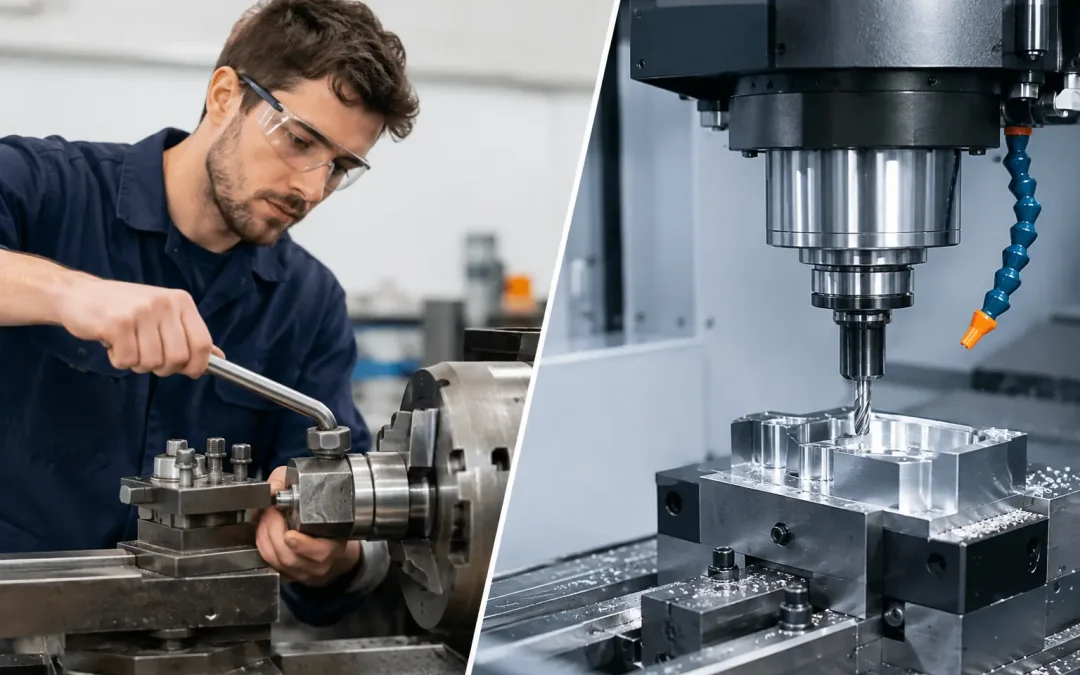
A repair job for one worn shaft does not need the same machine strategy as a repeat order for 5,000 tight-tolerance components. That is the real question behind manual versus CNC machining: not which technology is universally better, but which one protects your production schedule, labor capacity, and capital budget for the work in front of you.
For manufacturers evaluating used machinery, the decision can affect far more than cycle time. It influences quoting, operator staffing, tooling requirements, inspection demands, floor space, maintenance planning, and the speed at which a shop can respond to changing customer requirements. A practical comparison starts with the part mix and ends with the total operating picture.
Manual Versus CNC Machining at a Glance
Manual machines rely on an operator to control the cutting process directly. On a manual lathe, for example, the machinist sets speeds, advances the carriage, positions the tool, and verifies dimensions throughout the job. Manual mills, drill presses, grinders, and engine lathes remain valuable equipment in maintenance departments, toolrooms, job shops, and training environments.
CNC machines use programmed instructions to control axis movement, spindle speed, feed rate, tool changes, and repeated operations. A CNC vertical machining center, turning center, or multi-axis lathe can produce the same programmed features repeatedly with far less hands-on movement during the cycle. That capability is why CNC equipment is central to high-volume work, complex geometries, and applications where consistency drives profitability.
The distinction is not simply manual equals simple and CNC equals advanced. A skilled manual machinist can produce exceptional work, particularly on one-off components and repair tasks. Likewise, a CNC machine can be the right choice for a relatively simple part when production volume, repeatability, or labor availability justify the investment.
When Manual Machining Makes Business Sense
Manual machining is often the most efficient option for low-volume, variable, or urgent work. If a maintenance team needs a replacement bushing, a modified bracket, or a quick fixture adjustment, programming and proving out a CNC job may take longer than machining the component manually. For short runs, setup time can matter more than machine cycle time.
Manual equipment also gives experienced operators immediate control. They can make small adjustments as they work, respond to material variation, and complete repair-oriented jobs without creating a program for every change. This flexibility is especially useful in plants that support older equipment, manage frequent breakdown repairs, or handle a broad mix of nonstandard parts.
The capital requirement is another advantage. Used manual lathes and mills are generally more accessible than comparable CNC equipment, and they can be a sound addition when a shop needs capacity without taking on a larger automation investment. They are also mechanically straightforward, which can simplify certain maintenance and troubleshooting needs.
That said, lower acquisition cost should not be confused with lower production cost in every situation. Manual work depends heavily on operator time and individual skill. As quantities rise, labor cost and variation can quickly outweigh the savings at purchase.
Best-fit manual applications
Manual machines are typically a strong fit for prototypes, repair work, tooling adjustments, maintenance support, very short production runs, and straightforward parts that require hands-on judgment. They can also provide valuable backup capacity when a primary CNC machine is down or committed to production work.
Where CNC Machining Delivers an Advantage
CNC machining earns its value through repeatability, throughput, and the ability to hold complex specifications across a run. Once a program is developed and verified, a CNC machine can execute the same motions repeatedly, reducing the variation that can occur when an operator performs every movement by hand.
For production parts, that consistency improves more than dimensional control. It can make quoting more reliable, reduce rework, stabilize inspection results, and help operations leaders plan capacity with greater confidence. A properly matched CNC machine can also consolidate multiple operations. A machining center with an automatic tool changer may drill, mill, bore, tap, and contour a part in one setup, reducing handling between machines.
CNC equipment is particularly valuable when parts have complex contours, multiple features, tight tolerances, or recurring demand. Multi-axis capability can reduce setups and improve access to difficult features. CNC turning centers can produce repeat shaft, sleeve, fitting, and flange work at speeds that are difficult to match manually.
Automation features can further extend capacity. Bar feeders, pallet changers, parts catchers, probing systems, and robotic loading do not eliminate the need for skilled people, but they can reduce idle time and allow experienced personnel to focus on setup, quality, programming, and higher-value problem solving.
The Trade-Offs Buyers Should Evaluate
The right decision requires a complete view of ownership, not just a comparison of sticker prices. CNC machines typically require more infrastructure and planning. Depending on the model, a buyer may need adequate electrical service, compressed air, coolant management, tooling, workholding, programming capability, and service support. Older CNC controls should be evaluated carefully for condition, parts availability, and operator familiarity.
Programming is also a real cost. A simple repeat job may be programmed quickly, while complex parts can demand significant CAM time, simulation, fixture design, and first-article inspection. For a single part or a highly variable repair, that front-end effort may not pay back.
Manual equipment has its own constraints. Production speed is tied closely to the operator, and maintaining identical results over long runs can be difficult. Manual machines are less suited to unattended operation, complicated toolpaths, and processes requiring frequent, precise repetition. Shops that rely on one highly experienced manual machinist may also face a capacity risk when that person is unavailable.
A useful way to frame the choice is this: manual machinery tends to minimize commitment for flexible, low-volume work, while CNC machinery tends to minimize cost per part when repeatability and production volume increase. The crossover point varies by part complexity, setup time, cycle time, labor rates, tolerance requirements, and available staffing.
Questions to Ask Before Buying Used Equipment
Used machinery can provide a cost-effective path into either capability, but buyers should evaluate the machine against the actual work they need to win and complete. Start with the largest and most common parts your team produces. Consider travel, swing, spindle capacity, table size, horsepower, tooling format, and the workholding required to run those jobs safely.
For CNC equipment, ask whether the control is familiar to your operators and whether the machine can support the programs, tolerances, and cycle times you expect. Review spindle condition, axis movement, tool changer function, alarms, lubrication systems, coolant delivery, and available maintenance records. Confirm that rigging, freight, installation, and startup requirements are part of the budget.
For manual equipment, inspect backlash, ways, spindle bearings, feed mechanisms, gearing, and overall alignment. A machine may appear simple, but worn components can affect finish quality, accuracy, and operator efficiency. The availability of accessories such as chucks, vises, collets, digital readouts, steady rests, and tooling can also change the real value of a purchase.
It is equally important to look at the production bottleneck. Buying a fast CNC machine will not solve a delayed workflow if programming, inspection, or material handling is the limiting factor. Similarly, adding a manual mill may not improve response time if qualified labor is already fully allocated.
A Practical Equipment Strategy for Growing Shops
Many successful operations do not treat manual and CNC capacity as mutually exclusive. They use manual machines for maintenance, quick-turn modifications, secondary operations, and low-volume work, while CNC equipment handles repeat production and complex parts. This mix can keep high-value CNC spindle time focused on jobs where it delivers the strongest return.
For a growing shop, the next purchase should be driven by demand patterns rather than assumptions. If recurring orders are tying up skilled operators on repetitive work, CNC capacity may create a clear productivity gain. If the workload is unpredictable, repair-oriented, and low volume, a dependable manual machine may deliver faster payback and lower operating risk.
Revelation Machinery helps manufacturers evaluate and source used CNC and manual equipment with the speed and transparency needed to keep operations moving. The most productive purchase is not always the newest or most automated machine. It is the machine that fits your parts, people, budget, and delivery commitments well enough to keep earning its place on the floor.
Before committing capital, pull a representative sample of recent jobs and compare setup time, cycle time, tolerance requirements, and labor hours. That simple exercise often makes the right path clearer than any broad claim about which machining method is best.