
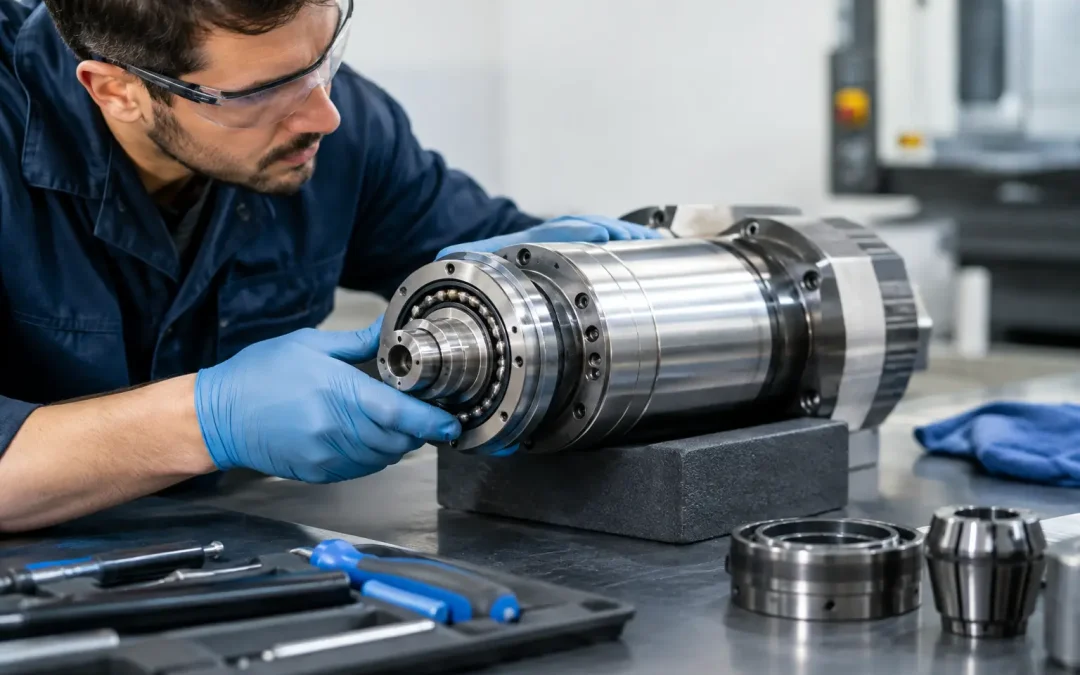
A spindle rarely fails at a convenient time. It starts with a finish issue on a high-value part, a vibration alarm during a production run, or a temperature trend that maintenance has been watching for weeks. This CNC spindle repair guide helps plant managers and machine shop owners make a sound decision before a manageable repair becomes an unplanned shutdown, scrapped material, or damaged machine taper.
The goal is not to encourage in-house spindle rebuilding. Precision spindle work requires specialized equipment, clean-room conditions, balancing capability, and experienced technicians. The goal is to help your team recognize failure patterns, collect useful information, protect the machine, and determine whether repair, replacement, or equipment replacement is the better business decision.
Start With the Symptoms, Not the Assumption
A noisy spindle does not automatically need a full rebuild, and poor surface finish is not always a spindle problem. Toolholder condition, tooling balance, workholding, program parameters, axis condition, coolant contamination, and material variation can all create similar symptoms. A disciplined diagnosis prevents a shop from spending repair dollars in the wrong place.
Spindle-related symptoms often appear in combination. Watch for rising vibration, unusual bearing noise, elevated housing temperature, runout that exceeds the machine’s normal baseline, recurring tool breakage, declining surface finish, or a change in load behavior during familiar cuts. On motorized spindles, fault codes, inconsistent acceleration, or reduced commanded speed may point to an electrical issue as well as a mechanical one.
The timeline matters. A sudden change after a tool crash calls for a different response than a gradual deterioration over several months. After a crash, stop and inspect the toolholder, drawbar retention, taper, spindle nose, and machine alignment before returning to production. Continuing to run a spindle with impact damage can turn a repairable event into a damaged shaft, housing, or motor assembly.
Protect the Evidence Before It Gets Worse
When a spindle begins showing symptoms, operators are often under pressure to keep the machine running. That is understandable, but running at reduced quality or with growing vibration can create a much larger cost later. If the machine can safely produce noncritical work within conservative limits, document those limits. If vibration, heat, or noise is escalating, take the machine out of service.
Before calling for service, record the machine make, model, serial number, spindle model if available, taper type, maximum RPM, hours, alarm history, and the conditions under which the issue occurs. Capture photos of the taper and spindle nose, along with video or sound recordings of unusual noise when it is safe to do so. Note the toolholder type, tool projection, RPM, material, and cutting operation involved when the problem appears.
This information helps a repair provider distinguish among common causes and quote work more accurately. It also supports a better internal decision when production asks how long the machine will be unavailable and whether a backup machine can carry the work.
Checks Your Team Can Perform Safely
Basic inspection should be performed with the machine locked out and according to the manufacturer’s procedures. Check for damage or fretting on toolholders, corrosion or scoring in the taper, coolant leakage near the spindle, loose retention knobs, and contamination in the air supply or lubrication system.
Measure runout only with clean, verified tooling and appropriate indicators. A poor measurement setup can falsely suggest spindle damage. Compare results to the machine’s historical condition or manufacturer guidance rather than relying on a universal number. High-speed finishing work may demand tighter condition than rough machining, and acceptable limits depend on the spindle design and application.
Avoid disassembling the spindle cartridge, opening bearing assemblies, or attempting to replace precision components in the field unless your team has the proper training and equipment. Improper preload, contamination, incorrect bearing orientation, and poor balancing can shorten spindle life immediately.
What a Professional CNC Spindle Repair Should Include
A quality repair process starts with inspection and measurement, not a blanket replacement of parts. The spindle should be evaluated for shaft damage, taper condition, bearing condition, housing integrity, drawbar performance where applicable, motor performance, encoder or sensor issues, lubrication pathways, and evidence of contamination.
For a rebuild, the technician may replace bearings, seals, spacers, springs, sensors, and damaged wear components. If the taper is worn or damaged, it may require regrinding or more extensive component replacement. Motorized spindles can also require winding evaluation, rotor balancing, connector repair, or drive-related testing. The correct scope depends on what failed and why it failed.
Ask how the spindle will be tested after repair. A dependable provider should be able to explain its run-in process, vibration testing, speed testing, temperature monitoring, balancing process, and final inspection documentation. The work is not complete when the spindle turns. It is complete when it operates predictably at the speeds and loads your production requires.
Turnaround time also deserves direct discussion. A repair that costs less but leaves a critical machining center down for weeks may not be the best value. On the other hand, paying for an expedited rebuild does not make sense for a secondary machine with available capacity elsewhere. The right decision depends on production exposure, lead times, available backup equipment, and the cost of missed deliveries.
Repair, Replace the Spindle, or Replace the Machine?
Repair is often the logical path when the machine is mechanically sound, controls are reliable, parts support is available, and the spindle issue is isolated. A successful spindle repair can restore a productive machining center or lathe at a fraction of the cost of replacing the machine.
Replacement may be the better route when the spindle has catastrophic housing or motor damage, the OEM unit is available quickly, or a repaired spindle would not meet the required speed, accuracy, or warranty expectations. In some cases, a spare spindle assembly is worth maintaining for high-utilization equipment because it reduces downtime during future service events.
Machine replacement becomes a serious consideration when spindle failure is part of a wider problem. Repeated repair needs, obsolete controls, unreliable drives, poor axis accuracy, unavailable parts, or capacity constraints can make another major repair difficult to justify. This is especially true when a shop is losing work because its current equipment cannot achieve required cycle times, tolerances, or automation needs.
A clear cost comparison should include more than the repair quote. Account for rigging, installation, lost production, operator retraining, financing or capital allocation, tooling compatibility, electrical requirements, and expected resale value. For manufacturers weighing a major repair against an equipment upgrade, Revelation Machinery can help assess used machinery options that fit the application, budget, and required delivery timeline.
Prevent the Next Spindle Failure
Most spindle failures are not entirely random. Contamination, poor lubrication, crashes, improper toolholder maintenance, unbalanced tooling, excessive tool projection, and operation outside recommended limits all contribute to shortened bearing and taper life.
A practical prevention program begins with clean habits. Keep tool tapers and holders clean and dry. Inspect retention knobs and replace damaged holders. Verify that coolant and lubrication systems are functioning correctly, especially after maintenance. Use balanced tool assemblies for high-speed work, minimize unnecessary projection, and follow sensible warm-up procedures after extended downtime.
Trend data is equally valuable. Record vibration, temperature, runout, and recurring alarm patterns for critical machines. You do not need a complicated predictive maintenance system to benefit from trending. A simple baseline and regular checks can reveal change early, when the shop still has time to schedule repair around production.
When Downtime Is Already Costing You
The best response to a spindle issue is a fast, informed one. Isolate the machine when conditions are unsafe or unstable, document the symptoms, confirm the likely source of the problem, and get a repair scope that explains both the work and the expected testing. Then compare that path against the real operational cost of waiting, replacing the spindle, or moving into another machine.
A spindle problem should not force a rushed capital decision. With accurate machine information, a realistic production plan, and the right support, your team can protect part quality now while choosing the option that keeps capacity available when it matters most.