
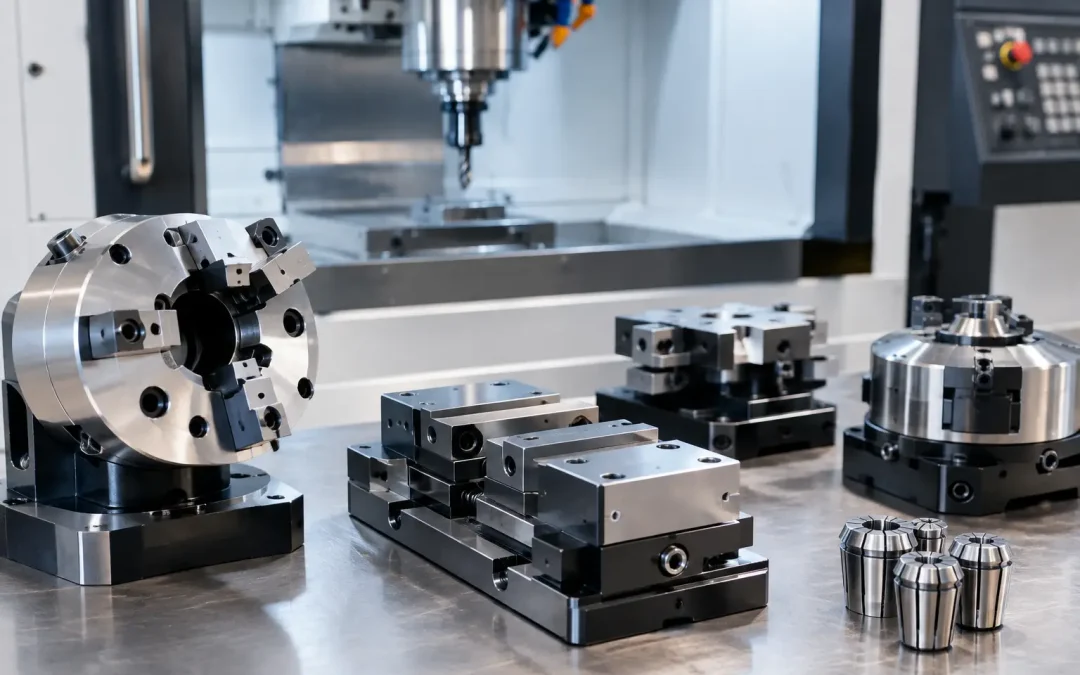
A machining center can have the spindle speed, travels, and control capability your shop needs, then lose accuracy and cycle time at the table. CNC workholding selection determines how securely a part is held, how many surfaces can be machined in one setup, and whether operators can load the next job without fighting clamps, chips, or inconsistent datum locations.
For shops buying used CNC equipment, workholding deserves the same attention as spindle condition, toolchanger capacity, and available axes. The right vise, chuck, fixture plate, or hydraulic system can extend the useful range of a machine. The wrong setup can create chatter, scrap, tool breakage, and avoidable operator time.
Start With the Part, Not the Fixture
The first question is not which workholding product is most popular. It is what the part requires. Review the material, blank form, finished geometry, tolerances, production quantity, and surfaces that must be accessed. A simple aluminum block and a thin-wall stainless casting may run on the same vertical machining center, but they need very different holding strategies.
Identify the features that establish the part datum. Whenever possible, locate from finished or stable surfaces that can be repeated from part to part. Then determine which areas can accept clamping force without distortion or damage. If a critical surface must remain untouched, the fixture needs to support and locate the part elsewhere.
Part geometry drives the decision. Prismatic parts often suit vises, toe clamps, or dedicated fixtures. Round stock may call for collet chucks, three-jaw chucks, soft jaws, or a rotary-axis solution. Thin parts may require vacuum workholding, adhesive methods, low-profile clamps, or sacrificial material to prevent movement under cutting loads.
The best option is often the least complicated setup that safely meets the tolerance and throughput requirement. A custom hydraulic fixture may be justified for a repeat production program. It is rarely the best capital decision for a short run that can be completed accurately with modular fixturing and properly prepared soft jaws.
Match Workholding to the Machine Envelope
Workholding consumes machine capacity. A large vise may fit on the table but limit Y-axis travel, interfere with the toolchanger, block a fourth-axis unit, or leave insufficient clearance for long tools. Before purchasing a fixture, confirm the full working envelope with the intended tools, holders, and probing routine in place.
On a vertical machining center, table size alone is not enough. Check T-slot spacing, table load rating, spindle nose-to-table distance, and available Z-axis travel. A tall fixture can force the use of extended tools, reducing rigidity just when the setup needs it most.
For CNC lathes, verify chuck diameter, drawtube compatibility, spindle bore, jaw stroke, hydraulic pressure, and clearance around the turret. Workholding for a turning center must also account for the part’s unsupported length. A part held securely at the chuck can still deflect or vibrate if tailstock, steady rest, subspindle, or live tooling support is not planned correctly.
Multi-axis machining adds another layer. Fixtures need clearance for tool approach angles and machine rotation. A setup that works well in three-axis milling may become unusable when the trunnion rotates because a clamp contacts the table, machine enclosure, or spindle housing. Model the sweep if possible, or physically verify movements before production begins.
Do Not Ignore Load and Balance
A fixture’s weight affects acceleration, indexing, and safety. This is especially true on fourth- and fifth-axis machines, where an off-center load can reduce performance and place stress on rotary components. Keep the center of gravity as close to the axis of rotation as practical, and stay within published payload limits for the rotary unit, not just the machine table.
Control Cutting Forces Without Distorting the Part
Clamping force must resist machining forces, but more pressure is not automatically better. Excessive force can bow thin material, crush softer alloys, mark finished surfaces, or create a part that springs out of tolerance when released. Insufficient force allows the workpiece to shift, chatter, or lift during machining.
Think about force direction. Downward clamping is valuable because it seats the part against locators. Side clamping without a positive stop can push a part away from its intended position. A practical setup uses locating pins, stops, rest pads, and clamps as a coordinated system rather than relying on clamp pressure alone.
The cutting strategy matters as well. High radial engagement, interrupted cuts, aggressive drilling, and heavy roughing create different loads than finishing passes. If the part or fixture lacks stiffness, reduce the cutting load, alter toolpaths, add support, or reconsider the workholding method. Trying to solve a rigidity problem with clamping pressure alone often creates a different problem.
Soft jaws are a practical example. Properly bored or machined soft jaws increase contact area, improve repeatability, and can support delicate shapes. They take preparation time, but that investment often pays back quickly when a lathe job requires consistent concentricity and faster loading.
Choose for Setup Time and Production Volume
A workholding decision should include labor, not just fixture price. A standard vise may cost less than a dedicated fixture, yet require repeated indicating, manual stop adjustment, and multiple re-clamps. On a recurring job, those minutes add up and introduce opportunities for variation.
For prototype and low-volume work, modular systems provide flexibility. Fixture plates with grid patterns, adjustable stops, clamps, and locating elements can be reconfigured for many parts. They are useful for shops with changing workloads and mixed production schedules.
For repeat production, consider quick-change pallets, zero-point systems, pneumatic or hydraulic clamping, and dedicated nest fixtures. These systems reduce setup time and can allow workholding preparation outside the machine while another part is being machined. The trade-off is higher initial cost, additional maintenance, and the need to standardize processes.
Automation changes the calculation. A robotic cell or pallet system needs repeatable loading surfaces, positive part presence verification, and predictable clamping. Manual workholding that depends on operator feel may be acceptable for a one-off job, but it is a poor fit for unattended operation.
Common CNC Workholding Selection Mistakes
The most expensive mistakes are usually not dramatic fixture failures. They are small, repeated losses in accuracy and uptime. Watch for these issues during planning and setup:
- Selecting a vise or chuck based only on physical fit rather than available tool access and travel.
- Clamping directly on thin, finished, or cosmetic surfaces without accounting for deformation and jaw marks.
- Using too few locating points, allowing the part to shift between loads or under changing cutting forces.
- Building a fixture around one operation without considering secondary operations, inspection, and deburring access.
- Assuming included workholding on a used machine is ready for production without inspecting wear, alignment, hydraulic condition, and compatibility.
Used workholding can represent real value, particularly when it comes with a machine package. It should still be evaluated carefully. Inspect vise ways and jaws for damage, check clamp screws and threads, confirm the condition of hydraulic lines and seals, and verify that fixture plates are flat. If the machine includes a fourth axis, review the chuck, tailstock, cables, and controller integration before assigning it to a critical job.
Build Repeatability Into Every Setup
Repeatability comes from controlling the basics: a clean locating surface, consistent material stock, defined datum points, adequate support, and a documented loading process. Chips trapped beneath a workpiece can defeat an otherwise excellent fixture. So can burrs on raw stock, worn jaws, or an operator who has to make judgment calls at every load.
Document clamp locations, torque or pressure settings, jaw machining dimensions, and inspection points for jobs that return. Photos and setup sheets are useful, but they should support clear physical standards rather than replace them. A repeatable setup lets experienced machinists move faster and gives newer operators a reliable process to follow.
When evaluating a used CNC machine, ask early whether existing workholding can support your target parts or whether new tooling and fixtures need to be included in the budget. Revelation Machinery can help buyers move quickly on dependable used equipment, but the machine purchase is only one part of the production plan. A well-chosen workholding system turns available machine time into accurate, profitable parts.