
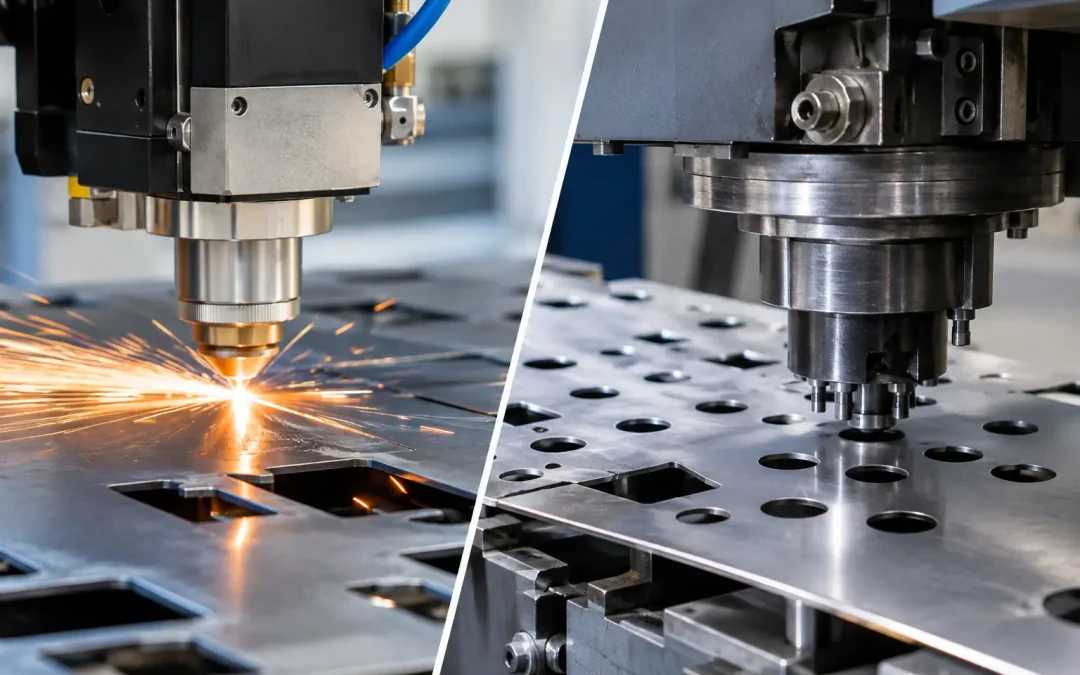
A quote can look attractive until a part design changes, a rush order arrives, or production volume triples. That is where the laser cutting versus punching decision becomes operational, not theoretical. Both processes can produce accurate sheet metal parts at scale, but they create value in very different ways. The right choice depends on part geometry, material, volume, secondary operations, labor availability, and the equipment already supporting your floor.
For fabricators evaluating used equipment, the goal is not simply to find the lowest purchase price. It is to add dependable capacity that protects delivery commitments and supports profitable work. A fiber laser and a turret punch can both be strong capital investments when matched to the jobs they are built to handle.
Laser Cutting Versus Punching: The Core Difference
Laser cutting uses a focused beam to melt or vaporize material along a programmed path. A CNC laser can cut external profiles, internal features, contours, and detailed shapes without dedicated tooling for each feature. Modern fiber lasers are especially effective on thin to medium-gauge steel, stainless steel, and aluminum, delivering high cutting speeds with a narrow kerf and consistent edge quality.
Punching uses a punch and die to shear holes, slots, and formed features into sheet metal. A turret punch press stores a range of tools that can be called automatically during a program. Once the right tooling is in place, it can produce repetitive features extremely quickly and can perform operations a laser cannot complete alone, including louvers, embosses, countersinks, dimples, and extrusions.
The distinction matters because a laser creates shapes by cutting paths, while a punch creates them by striking tools. One is highly flexible by design. The other rewards repeatability, planned tooling, and parts with common features.
When a Laser Cutter Is the Better Fit
A laser cutter earns its place when part variety is high and changeovers need to stay low. A new customer may send a one-off prototype in the morning and release a short production run in the afternoon. With the proper nesting and programming, the same machine can move from one job to the next without a tool change for every new hole shape or profile.
This flexibility is particularly valuable for shops serving OEMs, custom fabricators, architectural metal customers, and fast-moving contract work. Complex contours, odd-shaped cutouts, small holes, and frequent engineering revisions are generally easier to manage on a laser. It also eliminates the cost and lead time of purchasing special punch tooling for low-volume work.
Fiber lasers have changed the economics further. Compared with older CO2 systems, fiber technology can provide faster cutting on many thin-gauge materials, lower maintenance demands in key areas, and strong performance on reflective metals. The exact advantage depends on machine wattage, material type, assist gas, thickness, nesting efficiency, and operator workflow.
There are limits. Lasers may leave heat-affected edges, particularly on thicker material or sensitive applications, and some parts require deburring after cutting. Cutting speeds can fall significantly as material thickness increases. Nitrogen assist gas can also become a meaningful operating expense when customers require oxide-free edges on stainless or aluminum.
When a Turret Punch Press Wins
Punching is hard to beat when the job contains high volumes of standard holes, slots, perforations, or repeated features. A properly tooled turret punch can hit those features faster than a laser can trace each individual profile. That advantage compounds on recurring jobs where setup time is already absorbed and programs are proven.
Punching also adds capability beyond cutting. Forming tools can create tabs, louvers, offset forms, embosses, and other features that would otherwise require a separate operation. For cabinets, electrical enclosures, HVAC components, appliance panels, and similar work, reducing handling between machines can improve both throughput and consistency.
Tooling is the trade-off. Standard shapes such as rounds, squares, rectangles, and obrounds are widely useful, but custom tools require investment. Tools wear, need maintenance, and must be managed carefully. A part revision that changes several unique features can reduce the economic advantage of a punch press quickly.
Material behavior also matters. Punching places mechanical stress on the sheet and can cause distortion, burrs, or marking depending on the material, thickness, tool condition, and part design. Shops should consider whether a customer’s cosmetic and flatness requirements fit the process before quoting the job.
Compare the Real Cost, Not Just the Cycle Time
Cycle time matters, but it is only one part of the equation. The most productive machine on paper can become an expensive bottleneck if it needs tooling that is unavailable, frequent manual loading, extensive secondary finishing, or an operator with specialized experience.
A laser’s cost structure generally favors flexibility. There is no dedicated punch tool required for each new geometry, which reduces the barrier to quoting prototypes and short runs. However, owners should account for assist gas, consumables, optics or cutting-head maintenance, chiller performance, dust collection, and the condition of the resonator or laser source on a used machine.
A turret punch press may have a lower entry cost than a comparable laser and can be exceptionally economical for established production parts. Its total cost depends heavily on the available tool package. A machine with a well-maintained, broad tooling inventory can enter production quickly. A lower-priced press missing the tools required for your work may demand substantial investment before it generates revenue.
When evaluating either machine, review actual job history. Look at the materials you process, average sheet thickness, common hole patterns, annual quantities, and how often designs change. A representative part mix will tell you more than a theoretical speed comparison.
Part Design Should Drive the Decision
Parts with intricate outer profiles, frequent revisions, and varied internal cutouts usually point toward laser cutting. Parts with repeated standard features and formed details often point toward punching. But many production environments do not need to choose only one process.
A common workflow uses both. A punch press forms louvers, knockouts, and repetitive holes, while a laser handles unusual profiles, late-stage design changes, and overflow capacity. Some advanced combination machines integrate punching and laser cutting in one platform, although the right fit depends on volume, maintenance capability, and available capital.
Consider the downstream process as well. If a part moves next to a press brake, welding cell, powder coat line, or assembly station, the cutting method should support the finished part requirement. A slight savings at the cutting stage does not help if it creates rework, excessive deburring, or delays later in the route.
What to Inspect When Buying Used Equipment
Used fabrication equipment can deliver immediate capacity at a more efficient capital cost, but condition and support matter. For a laser, confirm the machine’s source type, wattage, operating hours, maintenance records, cutting-head condition, motion accuracy, controls, nesting software, and material-handling configuration. Ask for sample cuts in materials and thicknesses close to your regular work.
For a turret punch, inspect the frame, turret, clamps, drive system, hydraulic or servo system, controls, and any automation. Review the tool inventory closely. Tool stations, tool condition, and specialty forming tools can materially affect the machine’s practical value. A demonstration should include representative hits, indexing, forming operations, and part removal where applicable.
Also plan for installation realities. Power requirements, compressed air, assist gas, ventilation, dust collection, foundation needs, rigging access, and operator training can affect the true timeline to production. Buying with clear documentation, responsive support, and transparent machine information reduces risk when uptime is on the line.
Make the Capacity Decision With Confidence
The best purchase is the one that matches the work you can win and the work you need to protect. If your shop is quoting diverse parts, managing frequent revisions, or looking to expand into flexible short-run work, a fiber laser may provide the strongest path. If repeat production, formed features, and high counts of common holes dominate your schedule, a turret punch may produce a faster return.
Revelation Machinery helps manufacturers evaluate and source used fabrication equipment with the practical details in view: machine condition, available inventory, application fit, and the urgency of your production schedule. Before committing capital, bring forward a few representative parts and let the work on your floor guide the decision. The right machine should not just cut metal efficiently – it should give your operation more confidence when the next opportunity lands on your desk.