
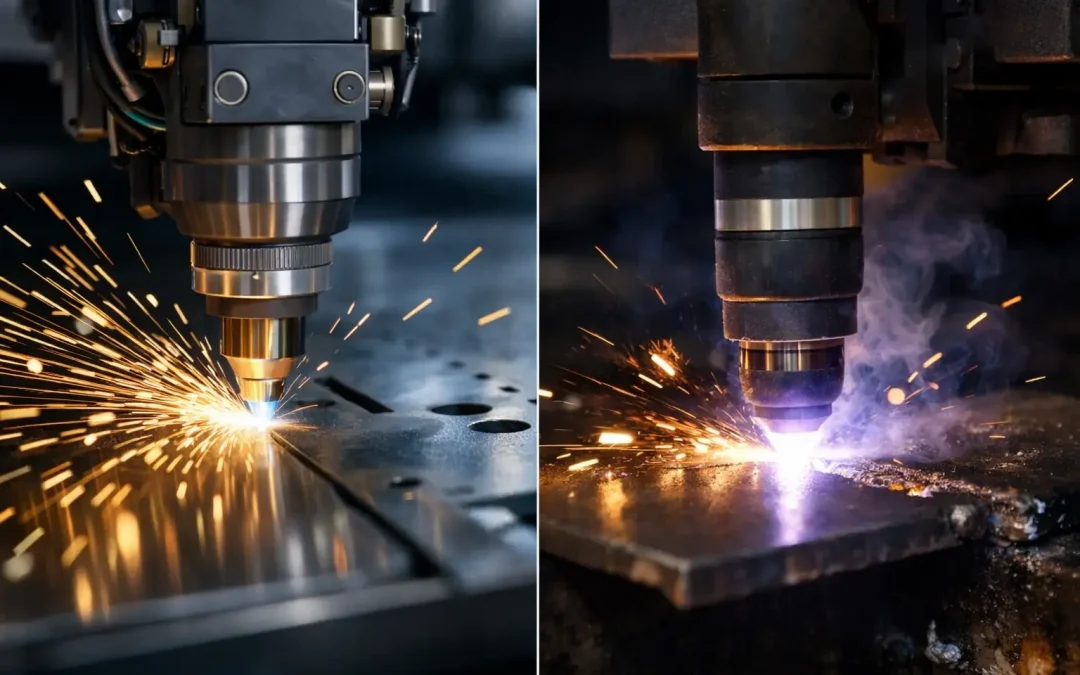
A cutting table that cannot hold tolerance, keep pace with demand, or control operating costs quickly becomes a production bottleneck. The fiber laser vs plasma cutter decision is not simply a question of which machine can cut metal. It is a decision about part quality, secondary labor, material mix, throughput, available utilities, and the capital plan behind your next equipment purchase.
For many fabrication shops, plasma remains a productive and economical answer for heavier plate. For precision sheet-metal work, a fiber laser often delivers a cleaner edge, tighter accuracy, and faster processing. The right choice depends on the work moving through your facility now and the work you intend to win next.
Fiber Laser vs Plasma Cutter at a Glance
| Factor | Fiber Laser | Plasma Cutter | | — | — | — | | Best fit | Precision sheet metal and high-volume profiles | Heavy plate, general fabrication, and lower-cost entry | | Cut quality | Narrow kerf, smooth edge, minimal heat-affected zone | Wider kerf, more dross, and more edge finishing in many applications | | Typical speed advantage | Fast on thin to mid-range material | Competitive or faster on thicker plate, depending on setup | | Operating inputs | Electricity and assist gas | Electricity, compressed air or gas, consumables, and often more ventilation | | Accuracy | Excellent for tight-tolerance work | Suitable for many structural and general fabrication jobs | | Initial investment | Usually higher | Usually lower, especially for conventional plasma systems |
These are operating tendencies, not absolute rules. Machine power, table design, material grade, thickness, nesting software, gas selection, and operator practices all affect results. A well-maintained high-definition plasma system can produce impressive parts, while an underpowered or poorly supported laser can miss its production targets.
Where Fiber Lasers Earn Their Keep
A fiber laser concentrates a high-energy beam into a very small spot. That focused energy creates a narrow kerf and allows detailed shapes, small holes, and fine features to be cut with strong repeatability. For shops producing brackets, enclosures, panels, HVAC components, fixtures, and other precision parts, that edge quality can reduce or eliminate grinding, machining, and rework downstream.
Speed is another major consideration. Fiber lasers are especially efficient on thin-gauge and mid-thickness sheet. When production involves frequent nests of aluminum, stainless steel, or mild steel parts, faster cycle times can improve machine utilization and shorten lead times. The machine may also support automated loading and unloading, making it a practical fit for lights-out or limited-labor operations.
Fiber technology also removes some maintenance burdens associated with older CO2 laser systems. There are no mirrors to align or laser gas mixtures to manage. That does not mean a fiber laser is maintenance-free. Optics need inspection, assist gas quality matters, chillers and dust collection require attention, and trained service support is essential when downtime is costly.
The trade-off is capital cost. A fiber laser table, material handling system, installation, electrical requirements, and supporting infrastructure can represent a meaningful investment. Buyers should evaluate total cost per finished part rather than purchase price alone. If a cleaner laser edge removes a manual finishing step across thousands of parts per month, the economics can change quickly.
Best applications for a fiber laser
Fiber lasers are typically strongest when precision, clean edges, and fast sheet processing drive profitability. They are well suited to repeat production, intricate contours, small hole-to-thickness ratios, and customer work that demands a polished appearance without substantial secondary finishing.
They can cut thicker material, but that does not automatically make them the most economical choice for a plate-focused shop. As material thickness increases, cut speed, assist gas consumption, edge requirements, and available laser power deserve closer scrutiny.
Where Plasma Cutters Make Sense
Plasma cutting uses an electrically conductive gas arc to melt metal and blow molten material out of the kerf. It is a proven process for carbon steel, stainless steel, aluminum, and other conductive materials. Conventional plasma systems provide an accessible entry point for fabrication operations that need dependable cutting capacity without the higher purchase price of a laser.
Plasma becomes particularly compelling in heavier material ranges. Structural fabricators, job shops, equipment manufacturers, and repair operations often process plate that is too thick for a fiber laser to handle efficiently. In these environments, the ability to cut heavy steel economically may matter far more than producing a near-machined edge.
High-definition plasma narrows the quality gap. It can deliver better edge squareness, finer detail, and less dross than conventional plasma, especially when paired with a capable CNC table, proper consumables, and optimized cut parameters. Still, plasma usually leaves a wider heat-affected zone and a rougher edge than fiber laser cutting. If parts must be painted, welded, or machined afterward, that may be acceptable. If they go directly to assembly or require a clean cosmetic finish, it may create added labor.
Plasma systems also require disciplined consumable management. Electrode, nozzle, shield, and torch components wear over time. Poor air quality, incorrect torch height, or delayed consumable replacement can reduce cut quality and raise operating costs. A shop that maintains its system well can protect throughput and part consistency.
Best applications for plasma
Plasma is often the practical choice for heavy plate, structural components, agricultural equipment parts, repair work, and mixed-volume fabrication where tolerances are moderate. It also makes sense for businesses that need cutting capability quickly but must preserve capital for welding, forming, material handling, or other essential equipment.
Cut Quality Changes the Real Cost of a Part
Comparing hourly machine rates alone can lead to the wrong purchase. The part leaving the cutting table may need deburring, grinding, drilling, machining, painting preparation, or inspection before it is ready for shipment. Those labor steps can outweigh a lower upfront equipment cost.
A fiber laser generally produces a smaller kerf, cleaner edge, and tighter dimensional control. That helps when nests contain close features or when material yield is critical. The lower heat input can also reduce distortion on thin material, which matters for parts that must fit precisely after bending or assembly.
Plasma produces more heat and a broader kerf, especially on thicker material. For a heavy weldment, this may have little impact. For a detailed stainless enclosure, it may create extra finishing work that erodes the apparent savings. Review actual part families, not generic sample cuts, before deciding.
Ask prospective equipment suppliers to cut representative material in your common thicknesses. Include holes, outside contours, sharp corners, tabs, and features that regularly create quality issues. A sample part reveals more than a brochure specification.
Throughput Depends on Material Mix, Not One Speed Number
Manufacturers often compare inches per minute, but productive cutting includes loading, nesting, pierce time, cutting, unloading, sorting, and rework. A laser may cut thin material at a much higher rate, yet its advantage can be limited if the table sits idle waiting for material. Conversely, plasma may be the better production tool for a heavy plate nest even if it cannot match laser accuracy.
Consider how often your shop changes material types and thicknesses. Also consider whether you need one flexible table or dedicated capacity for different product lines. A shop cutting both thin stainless panels and thick carbon-steel base plates may eventually benefit from both technologies rather than forcing one machine into every application.
Automation should be part of this discussion. Shuttle tables, tower systems, automatic load/unload equipment, and part sorting can improve capacity, but only when matched to order volume, floor space, and staffing. The right automation supports flow. The wrong level of automation can tie up capital without solving the actual bottleneck.
Buying Used: Evaluate the Whole System
Used fiber lasers and plasma tables can offer a strong path to added capacity, particularly when a business needs reliable equipment without the lead times and cost of new machinery. The inspection process should look beyond the nameplate.
For a used fiber laser, review laser source hours, service history, chiller condition, cutting head condition, motion accuracy, resonator performance, software availability, dust collection, and automation components. Confirm that electrical service, gas supply, ventilation, and rigging access are available at your facility before finalizing a purchase.
For a used plasma system, inspect the CNC control, table condition, rails, gear racks, torch height control, power supply, consumable condition, fume extraction, and compressed-air quality. Test cuts in materials and thicknesses that reflect your work. A machine that runs is not necessarily a machine ready to hold production tolerances.
Support after the sale matters as much as the inspection. Transportation, rigging, installation coordination, startup planning, and access to qualified technicians all affect how quickly equipment begins producing revenue. Revelation Machinery helps manufacturers source and sell used fabrication equipment with the practical guidance needed to keep transactions moving.
Make the Decision Around Your Next 12 Months
Choose a fiber laser when clean edges, tight tolerances, thin-to-mid-range sheet production, and reduced secondary operations are central to your margin. Choose plasma when heavy plate capability, lower entry cost, and general fabrication versatility carry more weight. If your volume and material mix are broad, the best answer may be a staged investment plan that adds the second process when demand supports it.
Before committing, pull twelve months of job data and identify the thicknesses, materials, tolerances, finishing steps, and recurring part quantities that define your operation. The best cutting machine is the one that turns that real workload into dependable capacity, not the one with the most impressive specification sheet.