
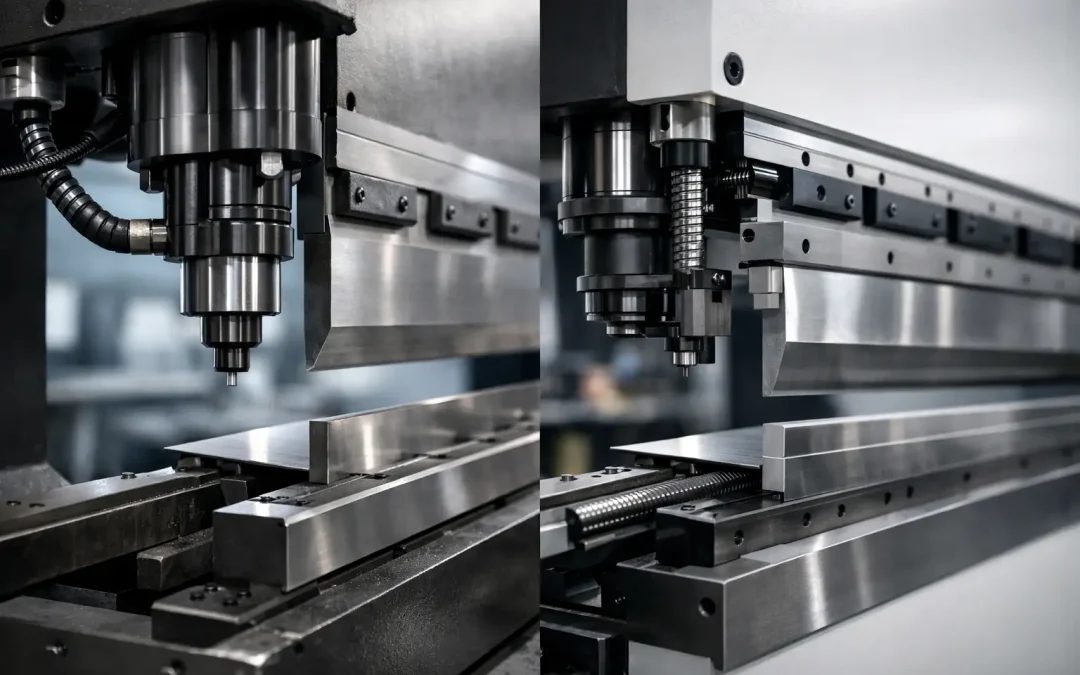
A press brake decision can affect quoting speed, labor requirements, utility costs, and your ability to keep production moving when deadlines tighten. In the hydraulic vs electric press brakes discussion, there is no universal winner. The right machine depends on the materials you form, the parts you run, required tonnage, shift schedule, available support, and the capital available for the purchase.
For many fabrication operations, a well-maintained used hydraulic press brake delivers the capacity and flexibility needed at a compelling price. For shops focused on smaller, repeatable parts and efficient short runs, an electric press brake may offer meaningful advantages in speed, energy use, and control. The key is to evaluate the machine against the work on your floor, not a specification sheet alone.
How Hydraulic Press Brakes Work
Hydraulic press brakes use hydraulic cylinders to drive the ram. A pump, valves, fluid reservoir, and control system regulate pressure and ram movement, allowing the machine to apply substantial forming force across the bed. This design has been a fabrication standard for decades because it is proven, capable, and widely serviceable.
The biggest advantage is tonnage. Hydraulic machines are commonly available in configurations suited to heavy plate, long bending lengths, deep box forming, and demanding production work. A large hydraulic brake can provide the force needed for thick material without requiring an unusually large electrical installation. For shops that regularly bend structural components, stainless plate, heavy-gauge carbon steel, or oversized workpieces, that capacity matters more than incremental gains in cycle time.
Hydraulic brakes also offer a broad used market. That gives buyers more choices across bed lengths, tonnage ratings, controls, and brands. An older conventional hydraulic brake may be a practical fit for straightforward forming work, while a newer CNC hydraulic brake can provide programmable backgauges, stored bend sequences, crowning options, and strong repeatability for production parts.
There are trade-offs. Hydraulic systems consume power to maintain pressure, generate heat during extended operation, and require routine attention to fluid condition, hoses, seals, valves, and pumps. A leak or drifting ram should be treated as a service issue, not as a normal condition of ownership. Maintenance is manageable when the machine has been cared for, but it must be part of the operating plan.
How Electric Press Brakes Work
Electric press brakes use servo motors and mechanical drive systems, such as ball screws, belts, or pulley arrangements, to move the ram rather than relying on hydraulic pressure. The motor draws significant power primarily while the ram is moving, which can reduce energy consumption during idle periods.
Electric machines are often valued for fast approach and return speeds, low noise, clean operation, and highly controlled positioning. They can be an excellent choice for precision sheet metal applications, including electronics enclosures, small brackets, architectural components, medical-related fabrication, and high-mix work where operators make frequent setup changes.
Because the drive is electronically controlled, electric brakes can deliver strong repeatability, especially on smaller parts and lighter material. They also eliminate hydraulic oil from the ram drive system, reducing the risk of fluid leaks around the machine. For facilities with strict cleanliness requirements or limited appetite for hydraulic maintenance, that is a real operational benefit.
The limitation is usually capacity and application range. While electric press brake technology continues to advance, many models are designed for lighter to medium-duty bending rather than the highest-tonnage or longest-bed applications. Buyers should confirm not only the rated tonnage, but also the machine’s available tonnage across the full bed length, throat depth, daylight, stroke, and tooling compatibility.
Hydraulic vs Electric Press Brakes: The Real Buying Factors
Tonnage is the first practical dividing line. If your shop bends thick material, runs long parts, or needs substantial forming force every day, a hydraulic press brake will often be the more realistic option. Hydraulic machines remain the workhorse for demanding fabrication because they scale effectively into high-tonnage applications.
If most of your work involves thinner sheet, shorter bends, and repeatable parts, electric technology deserves a close look. Faster ram movement and efficient operation can improve throughput, particularly when the brake is handling many small parts rather than a few heavy ones. However, cycle time alone does not determine output. Part handling, tooling changes, programming, material flow, and operator skill can consume more time than the bend itself.
Accuracy needs a careful definition. Electric press brakes are known for precise ram positioning and repeatability. That does not automatically mean every finished part will be more accurate. Material thickness variation, grain direction, springback, tooling wear, backgauge condition, and bend allowance programming all influence the final angle. A properly maintained CNC hydraulic brake with good tooling, accurate gauges, and the right crowning setup can produce highly consistent work.
Energy consumption is another meaningful difference. Electric machines generally use less energy when idle and can lower operating costs in applications with frequent starts and stops. The savings should be calculated against your actual production hours and local power rates, not assumed from a brochure. If the machine is only used intermittently, the payback from lower energy use may be modest. If it runs heavily across multiple shifts, efficiency can carry more weight.
Noise, heat, and shop environment can influence the decision as well. Electric machines tend to operate more quietly and do not require hydraulic fluid management. Hydraulic brakes can create more ambient heat and noise, although modern systems are far more refined than older designs. For a shop with limited space, climate-control concerns, or cleanliness requirements, those differences may justify a higher purchase price.
Used Press Brake Evaluation Matters More Than Drive Type
A used press brake can be a high-value investment when it is matched to the job and evaluated thoroughly. Drive type is only one part of the purchase decision. The overall condition of the machine, its controls, tooling, service history, and transport requirements often have a greater impact on ownership costs.
On a hydraulic machine, inspect for oil leaks, cylinder condition, ram synchronization, pump noise, valve response, and consistent holding pressure. Watch the machine cycle through a full stroke if possible. Confirm that the ram returns smoothly, the backgauge moves accurately, and the control responds as expected. Ask whether hydraulic fluid, filters, seals, or major components have been recently serviced.
On an electric press brake, evaluate servo performance, drive components, control alarms, ram motion, and the condition of ballscrews or other mechanical transmission parts. Verify that replacement parts and qualified service support are available for the model under consideration. A less common machine may look attractive on price, but savings disappear quickly if a critical component has a long lead time.
For either style, inspect the bed and ram for damage, check the tooling package, verify safety systems, and review electrical requirements before arranging delivery. Bed length, overall machine dimensions, weight, loading access, rigging, and installation space should be confirmed before committing to a purchase. A machine that fits the part but cannot be installed efficiently is not a low-friction solution.
Consider Your Work Mix Before You Commit
The best question is not whether electric technology is newer or whether hydraulics are more familiar. Ask what percentage of your production requires high tonnage, long bends, close repeatability, rapid setups, or extended unattended idle time. Then assess whether those needs are stable or likely to change over the next several years.
A job shop with unpredictable customer work may prioritize the versatility and availability of a hydraulic CNC press brake. A manufacturer running a narrow family of lighter-gauge components may gain more from an electric machine’s speed and efficiency. Many larger operations use both, assigning heavy work to hydraulic capacity and repetitive light-gauge work to electric equipment.
Budget should include more than purchase price. Account for tooling, freight, rigging, electrical work, operator training, preventive maintenance, software or control updates, and the cost of lost production if the machine is not ready when needed. A dependable used machine from a recognized manufacturer can protect capital while providing the capability required now.
Revelation Machinery helps manufacturers evaluate available equipment with the urgency and transparency these purchases require. Whether you are sourcing a press brake to expand production or selling surplus assets from a facility change, the right transaction starts with clear specifications and an honest view of machine condition.
Choose the press brake that supports the parts you need to make next week and the work you expect to win next year. Capacity, condition, support, and fit for your workflow will carry more value than choosing a drive system on reputation alone.