
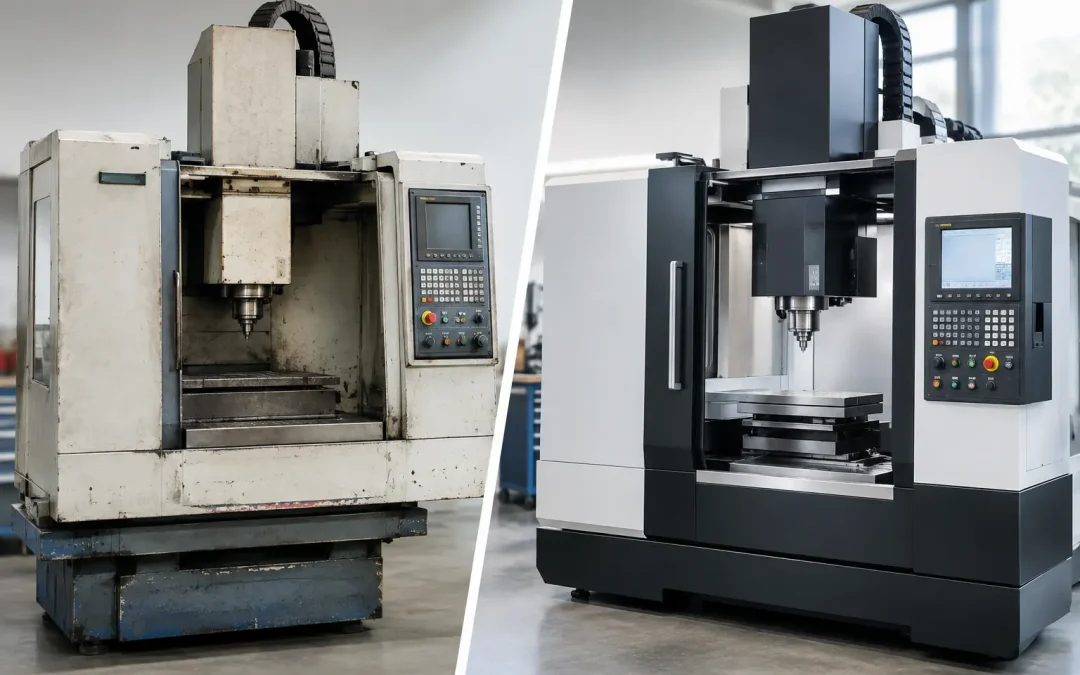
A control failure, rising maintenance costs, or a new production contract can force a difficult capital decision fast. In the CNC retrofit vs replacement discussion, the right answer is not simply the lowest purchase price. It is the option that protects throughput, holds tolerances, fits your labor capacity, and gives the business a realistic return on capital.
For many shops, a retrofit can extend the useful life of a proven machine. For others, putting more money into an aging platform delays an equipment change that is already overdue. The decision comes down to the machine’s mechanical condition, the work it needs to perform, the expected downtime, and the value of a more capable replacement.
CNC Retrofit vs Replacement: Start With the Machine Base
A CNC retrofit replaces or modernizes components such as the control, drives, motors, electrical cabinet, feedback systems, and safety equipment. The iron stays in place. A successful retrofit gives an otherwise sound machine a more serviceable control platform and can restore dependable operation without the cost of a new or late-model machine.
That approach only works when the underlying machine is worth saving. A rigid casting, sound spindle, accurate ways, and stable geometry are valuable assets. If the machine has been productive for years and its mechanical condition is well documented, updating the electronics may be a practical move.
Replacement means acquiring another machine, typically a newer used CNC machine or a new unit, that better matches the shop’s current requirements. It may bring faster rapids, higher spindle speeds, additional axes, larger travels, better chip management, automation compatibility, or improved probing capabilities. It also removes the uncertainty of trying to modernize a machine with multiple wear-related issues.
The first question is simple: is the problem primarily electrical and control-related, or is the entire machine approaching the end of its productive life? A control that is obsolete is not automatically a reason to replace a machine. Worn ball screws, declining spindle performance, way damage, persistent accuracy problems, and unavailable mechanical parts are stronger warning signs.
When a CNC Retrofit Makes Business Sense
A retrofit is often attractive when a machine has a strong mechanical foundation but creates operational risk because of obsolete electronics. Legacy controls can be difficult to troubleshoot, expensive to repair, and dependent on limited parts availability. One failed board or drive can turn a manageable maintenance issue into an extended production interruption.
Modernizing the controls can improve programming workflow, diagnostics, reliability, and access to commonly available components. It may also make the machine easier to operate for newer employees who are more familiar with current control interfaces. In a shop with specialized fixtures, established programs, and a machine that performs a narrow but profitable job well, those benefits can be substantial.
A retrofit can also be the right move when the machine is physically difficult or expensive to replace. Large-bed machines, specialty grinders, older horizontal boring mills, and purpose-built equipment can have a replacement cost far beyond the cost of updating controls. If the machine’s structure still delivers the required accuracy and capacity, preserving it may protect capital for other priorities.
However, retrofit budgets need to be complete. The quoted control package is only part of the project cost. Include engineering, installation, electrical work, software conversion, commissioning, operator training, tooling changes, and the cost of production lost during the work. If the spindle, lubrication system, hydraulics, or enclosure require attention at the same time, the total can increase quickly.
When Replacement Is the Better Investment
Replacement becomes compelling when the existing machine no longer supports the work the shop needs to win. A vertical machining center that cannot accommodate larger parts, higher-speed tooling, fourth-axis work, or unattended production can limit growth even if it remains technically operable.
A newer replacement can improve cycle time, repeatability, surface finish, energy efficiency, and operator productivity. It may also provide features that reduce setup time, including probing, tool monitoring, larger tool capacity, better coolant delivery, and more capable controls. Those gains should be measured against actual production requirements rather than assumed from a brochure.
Replacement is usually the cleaner decision when a machine has both electrical obsolescence and mechanical deterioration. Spending heavily on a retrofit does not correct poor geometry, unstable thermal performance, excessive backlash, damaged ways, or a spindle that needs major work. A modern control cannot make worn machine components perform like new.
It may also be the better path when downtime is non-negotiable. A used replacement machine that has been inspected, powered up, and prepared for shipment may be brought online faster than a custom retrofit project, particularly when a shop can stage installation during a planned shutdown. Timing varies by machine, contractor availability, and site readiness, but a replacement can provide a more predictable path when production schedules are tight.
Compare Total Cost, Not the Initial Quote
The purchase price is visible. The operational cost of choosing the wrong path is not. A useful comparison should account for the full ownership picture over the next three to five years.
| Decision factor | Retrofit | Replacement | |—|—|—| | Upfront capital | Often lower if the machine is mechanically sound | Higher, but used equipment can narrow the gap | | Downtime | Can be significant during engineering and installation | Can be planned around delivery and commissioning | | Capability gain | Usually improves controls and reliability | Can add speed, axes, capacity, and automation options | | Mechanical risk | Existing wear remains unless separately repaired | Lower when buying an inspected, well-maintained machine | | Resale value | May improve, but remains tied to the older platform | Typically stronger for recognized late-model equipment |
Calculate the cost of lost production honestly. If a critical machine produces parts for a customer every day, even a short disruption can result in overtime, outside processing, missed shipments, or strained customer relationships. A lower-cost retrofit can become the more expensive choice if it ties up a bottleneck asset longer than expected.
Then calculate the upside. If a replacement reduces cycle time by 15 percent on high-volume work, supports lights-out operation, or allows the shop to quote parts currently being turned away, the return may justify a larger investment. The key is to base the forecast on real job data, not best-case assumptions.
Evaluate Your Work Mix Before Making the Call
The best decision often becomes clear when the shop looks at its next 12 to 24 months of work rather than its last 12 months. If production is stable and the machine handles repeat work within tolerance, preserving a reliable platform may be sensible. If part complexity, volumes, material requirements, or delivery expectations are changing, replacement may create a better runway.
Consider the parts that create the most pressure on the current machine. Are setups too long? Is the machine short on travel, tool capacity, spindle speed, or axis capability? Are operators manually performing work that a newer machine could complete in one setup? These constraints have a direct impact on labor, lead time, and margins.
Also consider your maintenance team. A retrofit can be a strong technical solution, but it should leave the shop with documentation, support access, and components that can be serviced long after commissioning. A replacement should be evaluated with the same discipline. Ask about control type, spindle hours where available, maintenance history, under-power inspection, available tooling, freight requirements, and installation needs.
The Used-Machinery Option Can Change the Equation
The choice is not limited to rebuilding an old machine or paying new-machine prices. Quality used CNC equipment can provide a meaningful step forward in capability while preserving capital for tooling, labor, automation, or inventory. For growing shops, that middle path often makes replacement financially practical.
The value of used equipment depends on condition, configuration, brand reputation, supportability, and how closely the machine fits the application. A well-selected used vertical machining center or multi-axis lathe can deliver years of productive service. A poorly matched bargain can create the same downtime risk the shop was trying to eliminate.
That is why inspection and transaction support matter. Buyers should seek clear machine details, honest condition information, responsive answers, and a plan for rigging, freight, and delivery. Revelation Machinery helps manufacturers source used equipment with the speed and transparency needed to keep capital projects moving.
Make the Decision With a Clear Threshold
Set a practical threshold before authorizing either path. If the retrofit cost approaches a substantial portion of a comparable used replacement, and the old machine still carries major mechanical or capacity limitations, replacement deserves serious consideration. If the retrofit resolves the actual failure point at a controlled cost and the machine remains accurate, productive, and well suited to the workload, keeping it can be a disciplined investment.
Do not let familiarity make the decision for you. The machine that has carried the shop for years may still have more value to deliver, or it may be consuming attention that should go toward faster, more profitable work. Assess the iron, the production plan, and the total cost of interruption, then choose the path that gives your operation the most dependable capacity when it matters.