
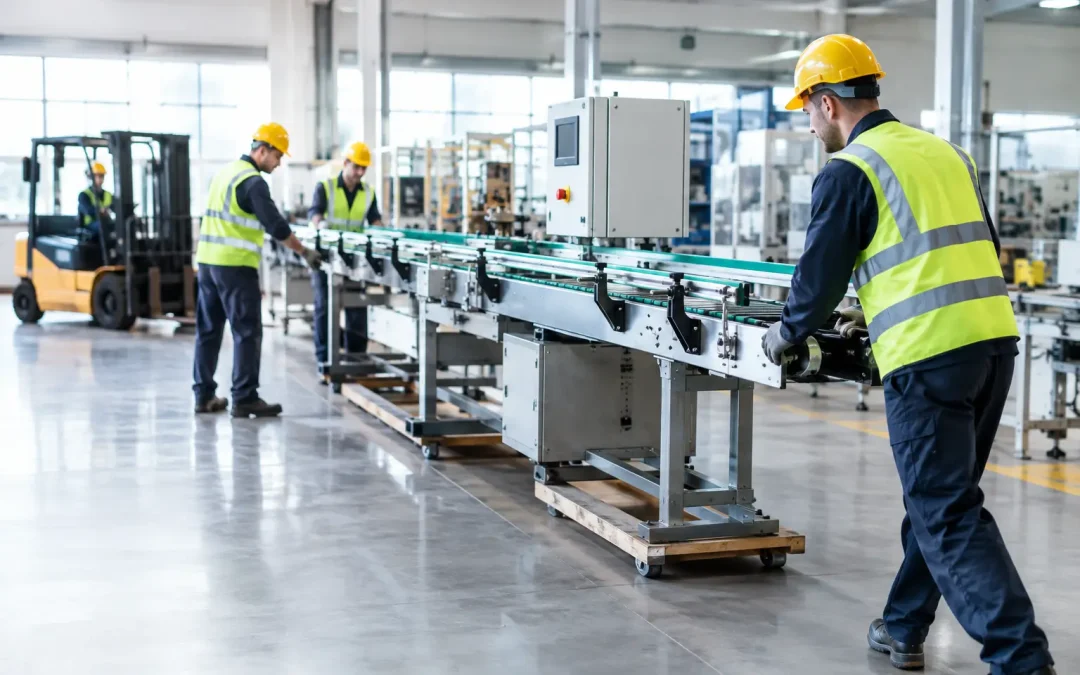
A production line relocation is not simply a rigging project. It is a controlled interruption to your operation that affects output, labor, quality, customer commitments, and cash flow. Whether you are moving one CNC cell across town or transferring an entire fabrication, packaging, or processing line to another state, the goal is the same: get the assets moved, installed, validated, and producing again with as little risk as possible.
The best relocations begin well before a machine is disconnected. They start with an honest operating plan, a complete equipment record, and clear ownership of every decision that can delay startup.
Start Production Line Relocation Planning Before Shutdown
A move date is not a plan. Before scheduling trucks or disconnecting utilities, define the business outcome you need from the relocation. That may be preserving a customer delivery schedule, consolidating two facilities, freeing up leased space, expanding capacity, or selling surplus equipment that will not make the move.
Start by separating equipment into three groups: assets required for immediate production at the new site, assets that can be commissioned later, and assets that should be sold or liquidated. This prevents a common and expensive mistake: paying to move machines that have no place in the future operation.
For each machine or production cell, document the manufacturer, model, serial number, dimensions, weight, electrical requirements, controls, tooling, accessories, condition, and current production role. Photograph the equipment before disconnecting it, including electrical cabinets, pneumatic connections, hydraulic lines, safety guarding, conveyors, chip systems, automation, and custom fixtures. A good record protects both the move and the restart.
It also helps to identify dependencies that are easy to overlook. A press brake may require specific tooling and a material handling path. A CNC machining center may depend on a chiller, mist collection, high-pressure coolant system, probes, workholding, and programmed offsets. Moving the main machine without the supporting equipment can turn a planned startup into an open-ended delay.
Build the Schedule Around Critical Production Paths
Not every asset needs the same level of urgency. A production line relocation should be sequenced around the equipment that restores revenue first. Identify the products, work centers, and machines that sit on your critical path, then build the shutdown and startup schedule around them.
This means coordinating more than rigging and transportation. Facilities work often determines the real startup date. Confirm that the new location has adequate floor loading, clearances, power, compressed air, gas, ventilation, drainage, network access, dust collection, and fire protection before equipment arrives. If foundations, pits, mezzanines, crane access, or utility upgrades are required, those items need to be completed first.
A practical schedule includes checkpoints for disconnection, labeling, rigging, loading, delivery, placement, utility connection, leveling, calibration, testing, and first-article inspection. Assign a responsible party and a deadline to each checkpoint. If a task has no owner, it is likely to become a problem during the move.
The trade-off is straightforward. A faster move may reduce the number of downtime days, but rushing site readiness can create longer delays after delivery. In many cases, staggered relocation is the better decision. Moving noncritical assets first gives the installation team time to solve layout and utility issues before the revenue-producing equipment arrives.
Protect the Equipment During Disconnection and Transport
Industrial machinery is built for production, not necessarily for travel. Improper preparation can cause damage that is not visible until commissioning. Sensitive components, loose tooling, hydraulic systems, electrical panels, and precision ways all require attention.
Follow manufacturer guidance where available. Lock or secure moving axes, drain fluids when appropriate, protect exposed surfaces, label every cable and hose, and package removed guards, tooling, manuals, and accessories with a traceable identification system. Back up machine parameters, PLC programs, control configurations, and production recipes before power is removed. For connected equipment, make sure the backup can be restored and verified at the new site.
Specialized rigging and transportation are especially important for large press brakes, fiber lasers, lathes, machining centers, injection molding equipment, and integrated automation. The lowest freight quote is not always the lowest total cost. A carrier or rigger without the correct equipment, insurance, permits, route planning, or machine-handling experience can create risk that far exceeds any initial savings.
Plan the New Layout for Better Output, Not Just Fit
A relocation is one of the few times a facility can reset poor material flow without interrupting daily operations. Do not reproduce an old layout simply because it is familiar. Review how material enters the line, where operators stage work, how finished parts leave, and where bottlenecks occur.
Look at aisle width, forklift traffic, ergonomic access, maintenance clearance, chip and scrap removal, tool storage, inspection stations, and safety zones. A machine may physically fit in a new building but still create lost time if operators cannot load material efficiently or maintenance cannot reach a control cabinet.
The right layout depends on the operation. A high-mix machine shop may prioritize flexible staging and quick access to multiple work centers. A packaging or processing line may prioritize straight-through flow and line balancing. A fabrication operation may need to keep material handling, laser cutting, forming, welding, and finishing aligned to minimize touches. The objective is not a perfect drawing. It is a layout that supports safe, repeatable output.
Commission in Stages and Verify Production Quality
Placement is not completion. Once equipment is installed, it must be leveled, connected, calibrated, and tested under realistic operating conditions. For precision machines, that can include geometry checks, spindle or axis verification, alignment, backlash review, coolant and lubrication checks, and safety interlock testing.
Then validate the process, not just the machine. Run representative materials and parts, inspect the first articles, confirm cycle times, verify programs and tooling, and review quality results against the previous site. If the line includes automation, conveyors, feeders, robots, or inspection equipment, test the handoffs between systems. A machine running independently does not guarantee that the full line will perform as expected.
Keep a controlled punch list during commissioning. Separate issues that prevent safe operation from those that can be corrected after production begins. This allows the team to focus resources on true startup blockers rather than treating every minor adjustment as equally urgent.
Decide What to Move, Sell, or Replace
Relocation creates a natural decision point for aging, duplicate, underutilized, or poorly matched equipment. Moving an asset can involve rigging, freight, storage, installation, electrical work, and lost production time. If the machine is unreliable, no longer fits your work, or has weak resale prospects after another year of use, replacement may be the more cost-effective option.
That does not always mean buying new. Quality used machinery can help restore or expand capacity quickly while controlling capital costs. It can also provide a temporary bridge when a new machine has a long lead time. Conversely, surplus machinery may have stronger value when sold before a facility closure or before it is left disconnected and exposed to storage damage.
Revelation Machinery helps manufacturers evaluate used equipment opportunities and turn surplus industrial assets into working capital through direct sales, consignment, or auction. The right approach depends on the equipment, timeline, market demand, and how much control you need over the sale process.
Keep One Team Accountable for the Move
A successful relocation requires operations, maintenance, facilities, IT, safety, finance, equipment vendors, riggers, electricians, and production leadership to work from the same plan. The risk is not that one group lacks expertise. The risk is that each group assumes another party is handling a critical detail.
Establish one relocation lead with authority to resolve scheduling conflicts and escalate decisions. Hold short, frequent status meetings as the shutdown approaches and during commissioning. Track open issues, expected delivery dates, utility readiness, equipment condition, and startup progress in one shared record.
Clear communication is especially valuable when unexpected conditions appear. A damaged connector, a delayed transformer, a missing fixture, or an inaccessible loading dock can happen on even well-managed projects. The difference is how quickly the team identifies the issue, assigns ownership, and protects the production schedule.
Treat the final startup as the beginning of the new operation, not the end of the move. When equipment, people, material flow, and quality checks are ready to work together, the relocation becomes a practical opportunity to return to production with a stronger, more efficient line.